Tuesday, May 13, 2014

Down Memory Lane with Debbie Miller, Treasurer


Board Member Profile: Down Memory Lane with Debbie Miller, Treasurer

I grew up riding horses starting at age six.  My family with seven kids were members
of the Donnellson Saddle Club so we'd enjoyed camp outs and trail riding at Shimek. We had a lot of fun growing up in the saddle club and made many good memories at Shimek. I can remember when there wasn't a lower campground and there was a single road in the upper campground with no loop. Where the day parking is now used to be a corral built similar to our hitching rails. We kids thought that it was cool to balance and walk around the top pole. It was an accomplishment to make it around without falling! That's where we tied our horses instead at the campsites. There was another hitching rail that was just a straight line about where the stalls are now. I don't remember designated camping spots with gravel and fire pits like we have now. No daytime parking; and there weren't any toilet pits either. The saddle club had a traveling porta potty we'd bring to the campground and for which they'd dig a hole. We also had a traveling chuck wagon we used to put our food to serve at our potlucks, which I loved. Probably why I suggested one in the Fall.
 
The Donnellson Saddle Club is the reason we now have water in the campgrounds. I think they used to haul water so when Rathbun Water was coming through, they came up with the funds to bring in the water. 
 
  Times have changed. I remember we hauled horses in pickup trucks and backed in the ditch in the upper campground to unload. There used to be card playing under the awning, especially if it rained. We also used to meet motor bike riders. I remember one time the club was on a ride and one of the members asked them to shut off their bikes until we rode through. I was thankful because my pony, as well as others, was spooked.
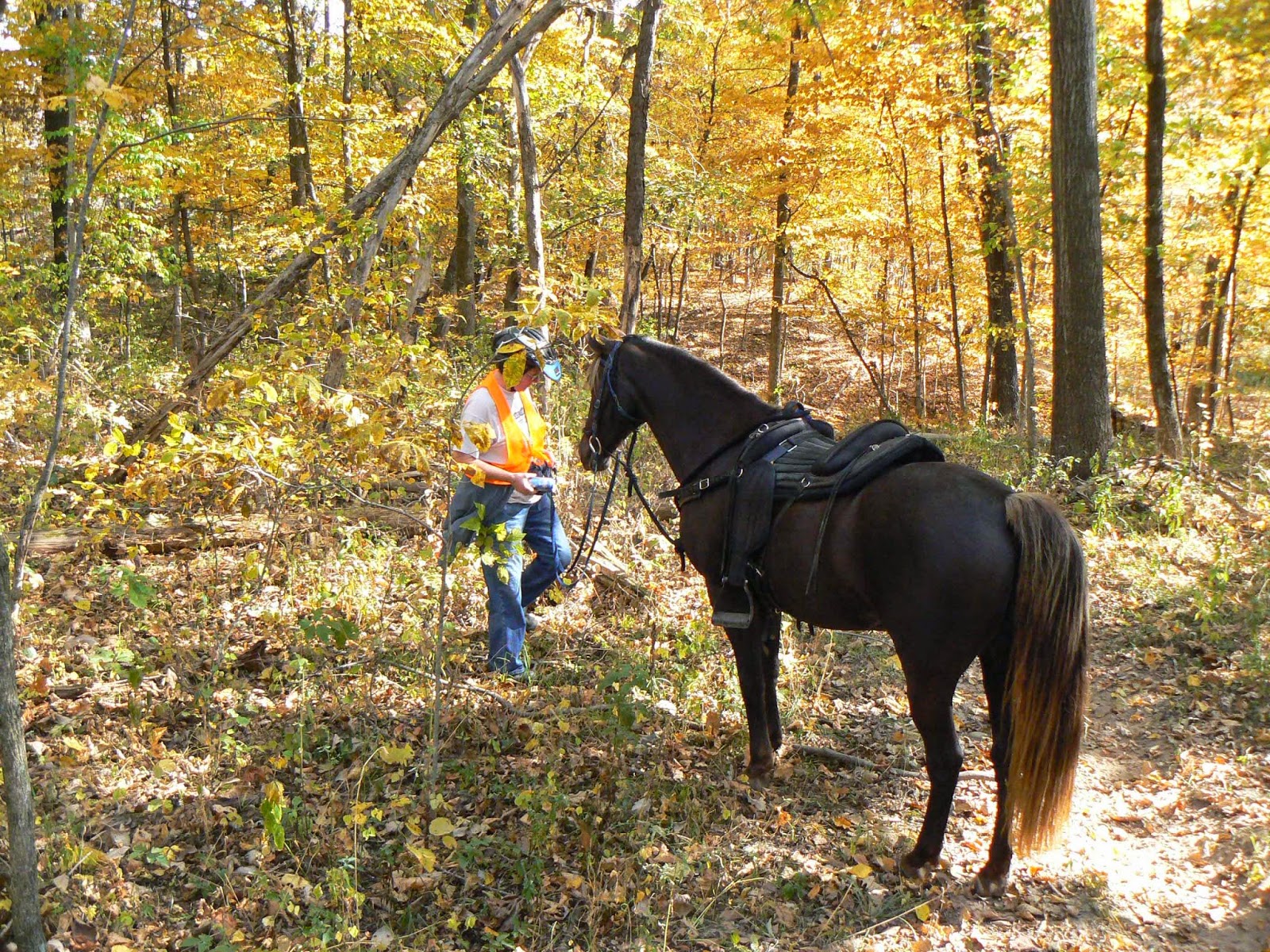
Debbie and Sonny at Shimek
The time I remembered the most was when the saddle club members got lost on the trails and we were supposed to be out on a short ride because the ladies were planning on making pizza and dessert pizzas over the fire. Then it got dark....nobody had a flashlight and people were using their matches to try to find the trail. My dad put me in front of him because I had a white pony that he could kinda see otherwise you couldn't really see your own horse's ears. If there was a low limb, everyone would holler back to the person behind them "low limb" because you couldn't see it. We didn't have to worry about it after one of the big guys couldn't get low enough and took it out.

We ended up coming out at a place that to this day
I think I know where it's at on the gravel road but I sure wouldn't know how to get there by horse. We rode the gravel road and came out by the curve before you enter the border of Shimek on the East side of Shimek on highway 2. We then rode all the way down highway 2 in the ditch to get to the entrance of Shimek and then rode another three miles up the gravel to the campground. To this day, I'll still say that was the longest ride of my life and if I'm riding towards evening, I always carry a flashlight.
 
I met Ann Bennett when a coworker, Diane Holmes, suggested I meet Lori Field and Ann because she thought we'd get along. Diane had her horse Buddy in training with Ann and suggested I take my problem child horse Sonny to Ann so I first met Ann when I took Sonny for some training. Ann then introduced me to Lori Field.
 
I remember the first time I met Marsha Achenbach was on a warm January /February day when Lori Field and I went riding. We started a fire and cooked hamburger brats and had some hot chocolate. Marsha was the only other rider out there and Lori knew Marsha and introduced me and I remember not promising to remember her last name of Achenbach. We invited Marsha to join us and there's been many times since when Marsha's trailer is the only other one there.
 
Neal Hartman and his sister Lala O'Hara I met through Marilyn Harris who was also in the Donnellson Saddle Club so I've known Marilyn all my life. Marilyn and Don Harris' dad Joe Harris and his friend Arnie Mitchell were responsible for a lot of the trails we have today.
Debbie and Neal heading back to clear trails after a lunch break during a Volunteer Work Day.
I first talked with John Byrd over the phone when one of his co-workers gave me his number. I was thanking his co-worker for all the good work they'd been doing and he thought I should call John because he said John wasn't used to hearing that. When I did call John, he said he wasn't used to hearing they're doing a good job, usually more in the complaining line. So when Ann called to see if I'd consider being Treasurer, I gave her John's name and number to call.

 Lora Conrad I met by a campfire at Shimek about six years ago. Ringo and Brenda Covert I first met at a volunteer work day at Shimek.

We are truly blessed with having Shimek so close to home and I'm blessed with 
all the good people I meet along the way...including on our Volunteer Work days.


WANTED: Information and photos on the history of the Equestrian Trails at Shimek State Forest

Debbie Miller, Neal Hartman and Don Harris have added a lot to the knowledge of your Editor and others about the history of the equestrian trails at Shimek. We would like to do one or more feature stories on the way the Shimek Trails were developed and used in the “good old days.” If you can share photos made during the early days of the trails as well as stories about your experiences in developing and/or using those trails, please send an e-mail to lpconrad@wildblue.net describing those experiences. You can send the photos via e-mail or mail them to me to be copied and returned. Thanks for your help---I've only been in Iowa since 2000 so do not have any personal knowledge of the history of the trails.

Wednesday, May 7, 2014

Riding the WWT

May 7, 2014  Riding the WWT

Today found the trails still listed as Ride WWT (Wet Weather Trails) only, so Marsha and I rode that loop.  This means that over 6 miles of Shimek's 25 miles of trails are open; the rest, closed to horseback riding.  The WWT is a loop that was rocked last year and has just recently begun to be  open when trail conditions are too wet to use the unrocked trails.  For the rules and the map that shows the trail---see the Friends of Shimek blog page titled "Open or Closed or WWT?

The WWT is about 2 to 2 1/2 hours of leisurely trail riding where most of the time two riders can ride side by side if they choose.  Today there were lots of things to see along the trail---though I did not get them all photographed. First of all, let me say that the morel hunters were having only a little luck and narry a one did I see from horseback along the WWT.  Another thing we did not see---there were no soggy, bad or dangerous places for riders on the WWT.

What we did see from horseback included turkeys and a bright blue bird that was too fast for me to identify.  Then there were many lovely wildflowers blooming along the trail.


 Between post 1 and Highway 2, there is a sweep of red or butcher's blood Trillium in bloom!  A most unusual sight to see so many blooming.   Please don't damage them---it takes several years for one to begin to bloom and then they can live for up to 25 years if not disturbed.  They seem to thrive in oak forests in light shade.


Everywhere, it seemed, along the trail the phlox are already blooming--and a not often sight awaited us near one of the water crossings---an area where phlox and blue bells were blooming together along a slope.

So---many Thanks to Forester John Byrd, to the Hoaglin Foundation for the rock and to the FOS and DNR personnel for their work in setting up an option for riding during wet conditions.

If we all cooperate and follow the WWT rules, then hopefully  next year, we can add  additional miles to the WWT!! Wouldn't that be nice !

Tuesday, May 6, 2014

Biosecurity for Trail Riders


Biosecurity for Trail Riders
from Friends of Shimek State Forest Equestrian Trails
 
Each year we face yet another equine disease threat.  Currently EHM is moving about in adjoining states and in Iowa, making us all uneasy about keeping our horses safe when out on the trails.  The following Biosecurity Guidelines have been prepared to help you avoid infecting your horse with a serious disease while out trail riding.


• Prepare before you go. Identify problematic infectious diseases in your area and in the area where you will be traveling and discuss preparation with your veterinarian, including obtaining vaccinations your horse should have, worming, Health Certificate and Coggins test. Do not take your horse to Shimek or anywhere there are other horses if he has a fever, shows any signs of illness or if you know he has been exposed to any horse with a contagious disease.


•Watch out for means of indirect contamination. If camping, BEFORE unloading your horse, be sure to remove all manure/bedding left at your site or in the horse stall you will be using. Disinfect the tie rail and any surfaces your horse may touch. If day riding, tie to your own trailer. (Bleach – water solution is good for this.)


• Don't share equipment. If you must lend tack or grooming tools, be sure to disinfect them before using again.


• Keep individual alcohol wipes handy in your trailer and in a pocket. Remember, something as simple as petting a dog that has just rolled in manure or used bedding can contaminate your hands.

• Horse trailers hauling horses from different locations should be cleaned out and disinfected after each transport. Once all organic material is removed from the trailer, a solution of two percent bleach and water is effective against most equine disease organisms. Disinfect the tires too.

• Restrict horse-horse contact: Keep your horse two horse-lengths away from any other horse even when stopped along the trail to assure the horses cannot touch. Viruses such as EHV-1 can be spread by airborne transmission as well as direct contact. (Note: There is no way to prevent nose to nose horse contact if using the horse stalls at Shimek and others are also using them)

• When tying your horse to a hitching rail or tie line, put enough space between horses from different farms that they don’t touch, share food or bedding.

•Control what your horse ingests. Many organisms can be ingested. Use your own bucket for watering your horse only and take the water from a faucet. Do not use a hose that has been lying on the ground or used by others.

• If you must water on the trail, water the horse upstream but be aware that some organism such as the Potomac Horse Fever fluke may be transmitted in open water.


•Bring plenty of clean hay for your horse as grazing around a campground could expose your horse to disease organisms. (EPM, for example, can be transmitted via grazing when the horse ingests infective sporocysts left by a possum. Organisms such as EHV-1 can be in the saliva of infected horses that may have eaten grass earlier. ) Do not feed the horse on the ground.


•Limit vector exposure. Ticks, mosquitoes and flies can transmit serious diseases as well as pester horses and riders. Insect repellants, appropriate use of fly sheets, rump rugs, and other horse apparel can all help reduce vector exposure. Check your horse and yourself carefully for ticks each day you ride.( The bite of infected mosquitoes is the source of West Nile Virus in both horses and humans.) Note rump rug and ear covers to reduce insect problems for the horse and helmet for rider safety in the photo.

• Restrict horse-human-horse contact. Don't touch another horse unless you need to do so. Be sure to disinfect your hands both BEFORE touching another horse and BEFORE touching your horse later. (Alcohol wipes are useful for this.)

• Disinfect your hands, clothes and boots before entering another horse stall or trailer and after returning home BEFORE entering your barn area.
• Before you leave the campground, clean up your campsite and stall. Please remove all bedding, manure, and left over hay that you and your horse have generated and dump it in the manure bunkers placed at each campground. This will allow drying and the sun to begin killing off any organisms and thus help protect the next camper and horse as most organisms survive much much longer in dark, damp environments.

(References and for more information see:
“Biosecurity on the Trail” from Equine Canada , http://www.cdfa.ca.gov/ahfss/Animal_Health/Equine_Biosecurity.html
and
USDA's “Biosecurity: The Key to Keeping Your Horses Healthy”)


Thursday, April 24, 2014

April 23rd at Shimek -Beauty and Surpise


Along the Trails on April 23rd
We have been in luck---there have been several April days dry enough for open trails at Shimek.  Marsha and I rode on April 23rd for a couple of hours.  By careful selection of trails to ride - by Marsha, we did not encounter any bad muddy places along the trails. As she rides, she has been making note of the locations of downed trees that must be removed at the May Volunteer Group Work Day.  

Despite the chilly cloudy day, the spring wildflowers are already making quite a show.  The redbuds are even giving a cast  of pink and promises of beauty to come in a few more days.  First of all, the serviceberries are blooming sprinkled all along the trails and through the woods--from shrubs 6 or 8 feet tall to loosely limbed trees of up to 30 feet with white blossoms quivering in the wind. See photo ----


Dutchman's breeches
The forest floor is just beginning to erupt with flowers.  Right now the Dutchmen's breeches are everywhere--waving in the breeze above the green fernlike foliage. (Sorry--no morels in sight.) 


False rue anemone


Also sprinkled all along the forest floor are false rue anemone--blooming later than usual.  There were also occasional spring beauties and one lone blue bell with its flowers showing more pink than blue at the moment but promising that there will be more blue bells later for us to see.  The blue bells do grow almost in the trail --so you'll have to watch to not let your horse step on them.

Despite the volunteer efforts already by Ringo and Brenda Covert and Marsha and Bob Achenbach, beer cans have once again been "sown" by the trail by a few trashy riders. 
More to do that should not be necessary on our work day---but we'll need to pick them up to better enjoy the scenery by the trails.  See you there on May 14th!

The best surprise of the day ---see below!

Lower Campground April 23rd - Old Horse Stall being Replaced 

Forester John Byrd and his DNR Crew are already beginning work on replacing the old horse shelter with a new, covered one.  The old stall was removed on April 23rd, and the pad cleared off---ready to begin construction!  DNR has provided funds in the Shimek Forest Campground budget to allow John and his crew to replace this old horse shelter at the lower campground.  The DNR crew will do the construction of the new shelter----as well as this de-construction of the old one.

Not often a bit of plain cleared ground looks so good---but this is step 1 in replacing that old decrepit horse shelter at the Lower Campground with a new covered, safer, shelter by John Byrd and the DNR crew.  Great news!

Monday, April 14, 2014

Coming Soon: "You are Here" Signs for Shimek Equestrian Trails


No More Being Lost for Hours on the Shimek Trails...Signage on the way!!

Debbie Miller and Marsha Achenbach are the Signage Development Committee for the FOS Board. They have been working on a plan for markers that will help any rider re-orient themselves with “You are Here” signs placed at critical locations along the trails. However, buying such signs looked like a daunting expense. But FOS Volunteers are wonderful!! Dennis Hunter volunteered to make 16 sign holders for marking trail intersections!  He provided all necessary materials and even the T-posts!     He waterproofed seams and painted sign holders red, provided heavy plexiglass to slide in from BOTTOM, so no rainwater, and a small screw to hold paper in so it will be easy to change maps. Bob and Marsha Achenbach have volunteered to scrub and paint the T-posts with paint provided by DNR. John Byrd has updated the map and a color copy of the trail map will be used in each, after Marsha marks the spots on the maps that she and Debbie determined as best for the location of the signage. Then—yes--more volunteer time will be needed as one of our May work day projects will be to install these signs. THEN---you will not often be more than a mile from a “You are Here” sign ….so now you won't be lost but for a mile or so.

Special appreciation is due to Dennis Hunter for the 45 hours of volunteer labor and about $500 in materials that he donated for constructing the metal sign holders.
 
This photo shows Dennis and Melinda Hunter behind one of the new sign holders and Debbie Miller and Ann Bennett admiring it. (Photo by Thomas Bennett)

Sunday, April 13, 2014

Profile: Marsha Achenbach, FOS Vice President


Continuing our series on FOS Board Members and their history with Shimek:
Marsha Achenbach, FOS Vice President and her husband, Bob Achenbach

My parents moved to Keosauqua in 1976. While visiting them sometime in the late ‘70s, we took a “drive” (us older ones may well remember the “Sunday drives” that were common way back), and found the Lick Creek unit of Shimek State Forest. I do remember the upper campground, but not the lower camp; either we did not drive far enough in, or it wasn’t there yet.

Years passed; the fact there were horse trails reasonably close stayed in my mind, but I didn’t visit Shimek again until the mid 90s. We had gotten involved in endurance competitions (50 and 100 mile races) and most of the non-winter seasons were taken up with that activity. One year, our daughter Jen and I made a trip down to visit my parents; this time coming with 2 horses, and camped at Shimek. Visited my parents and rode the trails; rather fast as we were on seasoned horses, so got most all the trails that we could find to get an idea of the system layout. The next year, Bob and I repeated that visit/camp/ride trip.

As my parents aged and showed signs that they would need help in the near future, we made the decision to move back to Iowa from Wisconsin. The existence of the horse trails at Shimek was a prime factor in this proposed move; did need trails nearby!! In retrospect, we would like to have found a property closer to Shimek, but bought a small farm west of Keosauqua and moved in late summer 1997.

Once the move was done--- by Bob with our 4 horse trailer as a “moving van” over many trips back and forth, I started hauling to ride at Shimek multiple times a week as long as the snow didn’t shut me off the access road. As I worked evening shift, most riding was in the morning or weekends. I recall seeing this lovely young woman on a lovely big Appy out on the trails; years later actually met Pat Pollpeter. Also can recall a couple other young women out riding and eventually met them: Debbie Miller and Ann Bennett.

Even when riding Chip on a beautiful fall day,
Marsha still takes time to stop and pick up a tossed can from beside the trail.
 About 12 years ago at one of my trips to our Amish farrier, Devon Weaver, he mentioned that a place a bit west of us was for sale again. I lamented that this time I hoped someone with horses that actually rode them would buy the place. He said that it was further off, but he had met a couple new to the area that had Arabs (we still had a couple then). He remembered their last name and the area they lived; so I found a phone number for Ray and Lora Conrad. Decided, what the heck, and called to invite myself over to meet their horses!! Really glad that I did as Lora and I have been riding together ever since.

Although I ride most horse trail systems in Iowa and some in Illinois and Missouri; Shimek remains my favorite place to ride. 

Note: Look for Marsha riding Gussie, her recently acquired paint TWH mare, or Chip out on the trails.

FOS Volunteer of the Year Doug Moothart Honored


Doug Moothart Honored

FOS Volunteer of the Year in 2013, Doug Moothart, has been selected as Trail Blazer Magazine's “Trail Warrior” for April 2014. He has not only been a dedicated volunteer at Shimek but as you can see below, supports Brinton Timber as well. Congratulations from the Board of Directors of FOS to Doug!
Doug and Dusty pause from their work. . Photo by Bonnie Moothart.
The nomination was submitted by the Iowa Trail Riders Association: Since 2007 Doug Moothart has adopted a beautiful Washington County park named Brinton Timber in the midst of 1000 acres of native timber along the Skunk River in southeast Iowa.  The park itself is 320.5 acres,  with  6-7 miles of hiking and equestrian trails that wind in and around the timber, crossing the rocky creeks and leading riders by splendid limestone outcroppings, and leading  up to spectacular bluff top views of the beautiful Skunk River below.  Brinton Timber was acquired in 1967 through a major donation by the Brinton family, and another portion of it was added in memory of Bill Horton in 1993.  Over the last 6 years Doug has orchestrated improvements to the park by coordinating 4-H club leaders, saddle clubs, and local equestrians.  A major project was the construction of 6 horse tie rails to protect the trees in the parking area that were getting girdled and trampled. Doug installed signage purchased by the County Conservation Department that implores riders not to tie to trees.  He also coordinated the turn around parking area improvements with the Washington County Conservation Department, Secondary Road Department and local equestrians that bought road rock.  Doug operated his own skid loader and donated the time and labor to spread the road rock and clear more areas adjoining the parking area.  Doug and his wife Bonnie patrol the timber trails on a regular basis through out the year using their own equipment to pick up trash and cans, clean up the parking/camping area, repair vandalism, cut downed trees from the trails, re-route and rebuild dangerous trails and crossings - all with the approval and permission of the Washington Conservation Department.  Doug continues to study trail maintenance techniques from other areas he rides, collecting ideas for stopping trail erosion and improving footing while protecting the native flora.  The results of his efforts has been highly increased trail and park usage due to the improvements, and gaining the respect and appreciation of hikers, nature lovers and equestrians to protect the park.  Doug receives feedback from a network of communication by social media and word of mouth about the improvements, and suggestions about park needs, which he happily and quickly attends to. Doug deserves to be recognized as a Trail Warrior.


*************C O N G R A T U L A T I O N S , D O U G*********************


Wednesday, April 2, 2014

2nd Annual Forest Education Day: Identifying Trees in Winter


Friends of Shimek 2nd Annual Forest Education Day March 22, 2014
Identifying Trees in Winter
John Byrd, Area Forester, Presenter
(Notes by Lora Conrad who is responsible for any errors in content.)

A cold windy morning with none of the promised sun---but 22 of us hiked along a trail in the Donnellson unit of Shimek with John Byrd in the lead---
-explaining how to identify trees---without green leaves on them!
 With leaves, identification is, well, a bit easier to say the least---just go to the ISU Forestry Site
 and proceed with the identification questions—wala---an answer will be found.


(I'm not saying it will be right for that depends on the accuracy of our answers.)

But on a cold day in March when only a few buds are beginning to swell---how do you decide what kind of tree is right in front of you? Below are the ones we looked at and how John explained to identify them---of course—he is speaking from the experience of looking at thousands of trees every year for “a few” years. So don't expect to get them all right the next time you go hiking or riding at Shimek---but you should get more of them right.

For photos in a slide show made during the session

 https://picasaweb.google.com/lpconrad/Mar222014FriendsOfShimekEducationDay#

Below is the description  for identifying each of the
trees we studied with photos at the above location.
     
    
#1 Post Oak. To determine if it is an oak, look at twigs. ALL oaks will have three buds at the tip of a twig. For a post oak, look at the bark---it will be “checky.” A post oak is in the white oak family, with sweet acorns for wildlife. Post oak can grow in very poor sites, rocky out-croppings and such, which creates poor wood quality. If growing on a good site, it can be better quality economically. All white oaks have a fungus on the bark—for post oak it becomes patchy in appearance. Then, look under the tree for some dried leaves--- post oak leaves have a cross shape like this:

#2 White Pine. None of the pines are native to southeastern Iowa but some acreage in Shimek was planted to several varieties of pine years ago. White pine is found native in northeast Iowa in a few areas. Here one is in luck as, of course, the needles are still upon the tree and there will be some on the ground. It is identified easiest by its needles which are soft and grow in bundles of five, 3-5 inches long, bluish green, with fine white lines .
 
#3 Shagbark Hickory. For a tree 5 or 6 inches in diameter or larger, it is easy to identify by its bark with peeling edges that give it the “shaggy” appearance. However, when it is young, its bark is as as smooth as other hickories. For younger ones, look near the base and you might see it begin to develop the shaggy signature. The twig on all the hickories will show the characteristic evidence of alternate compound leaves. The bud and twig can help distinguish among the young hickories. The bud of the shagbark is a long, large terminal bud whereas the bud for the bitternut is smaller and yellow. The mockernut twigs are hairy but those of the shagbark are smooth.
 
#4 Mockernut Hickory. This tree is mostly found in southeastern Iowa, including Shimek, but not much further north. Stand back from the tree a bit and look at the bark---mockernuts have a diamond shape in the bark—which shagbark does not. It also has a large terminal bud but it is not yellow like the bitternut hickory. If there are dried leaves under it, you will notice they have a longer stem than other hickories.
 
#5 Black Cherry. Trees are easiest to identify by their characteristic black, platy scales on the bark. It often grows faulty or does not get over 12 to 14 inches in Shimek. However, the fruit is very much used by wildlife. It grows best in the well drained soils of the eastern US. It is a very valuable tree used for lumber for cabinets and furniture. Heartwood is a light pinkish brown when freshly cut, darkening to a deeper golden brown with time and upon exposure to light. Sapwood is a pale yellowish color. The wood can be soaked to spread the color evenly into the sap wood to achieve the even color desired in the lumber.

#6 Swamp White Oak. This tree grows in wet or dry conditions. It has checky bark like the post oak. Distinguish it by the bark on the twigs. Most oaks have fairly smooth twigs but for the swamp oak, the twigs and small branches have a crumbly, easy to peel bark.
 
#7 Ash. There is lots of small ash in Shimek. EAB has not yet been found in Shimek but it has been found in adjoining counties. Shimek is included in the state restrictions on the movement of Ash timber and firewood. To tell a young ash from a walnut which looks similar, rub the bark. If its still dark under the surface its walnut; if light, its ash. For the ash, new branches emerge opposite each other on the limbs—so look up into the tree for that branching pattern. (Note: Boxelder also has opposite branching, but has waxy buds.)

#8 Shingle Oak. This is one of the best wildlife trees in Shimek as it has lots of small acorns and is very prolific. It is in the Red Oak family so its wood is not as valuable a timber tree as White Oak. Its wood is used most often for pallets or firewood. One way to help identify it is that it retains many of its leaves dried on the tree until it starts to bud in the spring. Another way to identify it is that it almost always has those prominent walnut sized black balls or wasp galls on it. These do not harm the tree unless it is heavily loaded with them. The wasp causes an irritation on the tree limb and the tree makes the gall. The gall wasp is a beneficial small insect that does not sting. Its leaves are not the classic oak shape we expect. You may find leaves under it that while dried and rolled up in March. will look like this with a tiny sharp tip on the end.

#9 Red Oak vs. Black Oak. Both are part of the same oak family—with leaves with pointed tips on the lobes. The red oak has silvery streaks in the dark bark (and does not have the galls of shingle oak)...see photo here. The Black oak tree will have black color in the lower part of the trunk and the trunk will have a checker block pattern that the red oak does not have. Just to make it interesting, these two trees will hybridize---thus making it even harder to tell what you are looking at. But then, they are about the same in wood quality. The white oak acorns are sweeter to wildlife and the tree puts much energy into their production but in an irregular cycle. Red oaks most often bear every other year though sometimes that can mean certain limbs on the tree are bearing in different year cycles. If there are acorns under the tree, the acorn cap of the red oak is small but that of the black oak extends half way up the acorn.
 
#10 White Oak. This is the life-blood species of Shimek forest. It has a beautiful, light wood in high demand for flooring, cabinets and furniture. It produces excellent acorns for wildlife. The trees grow very large and some are left to grow extra large to seed the forest floor for the next generation of oaks. Much of the forestry work to redevelop the white oaks involves harvesting trees to see that enough sun light reaches the forest floor for the young white oak seedlings as they will lose out to more shade tolerant species if that is not done. The bark is a lighter color than the other oaks—an ashy gray. As it ages, the bark furrows and makes blocky plates. John took a core sample of a tree that will have to be cut anyway to show the attendees that after the surrounding tees had been thinned, the white oaks growth rings were wider than before. This is how he assesses if the thinning is working to increase the growth of white oaks.
 
#11. Elm. A lovely vase shaped elm about 8 or 10 inches in diameter stood along the trail. To identify elm, look for many spindly branches up in the tree. Note that the buds will begin to swell and open very early. Despite the Dutch elm disease, there are still many smaller elms, and in fact much of the understory can be young elms since it thrives in shadier areas of the forest. Most do not grow very large as a result of the disease. When used for something like veneer, elm can be extremely valuable, especially Red Elm, but finding a great Elm takes a lot of looking. Most elm goes to the pallet mill.
 
#12 Ironwood. The ironwood (or hop hornbeam) tree with its rough bark looks a lot like elm –it is an understory wood. It has twigs that are thin and spindly also. It holds its little leaves all winter. It is called ironwood because it grows very slowly making a very dense hard wood but it does not get very large.
There are still more trees to learn--- maybe we can do that next year.
 
Looking for a tree for your yard or some for your farm? Check out https://www.arborday.org/trees/index-choosing.cfm to help you decide what might work best in your particular circumstances. The DNR announced that the State Forest Nursery has a great selection of quality trees and shrubs for sale to improve your property.  These conservation seedlings are fantastic for aiding in erosion control, improving wildlife habitat, establishing food plots for you or wildlife, and for creating personal timber/forest area. For more information on ordering trees or seedlings available, contact the State Forest Nursery at 1-800-865-2477 or go to www.iowatreeplanting.com
 
Seen any Red or Blue Paint On A Tree in Shimek?
If we see blue paint around a tree, when we are riding or hiking in Shimek, that tree has been marked to be harvested. John explained: Harvesting is done because we are managing for oak forests.  As it goes in life, the species you want the most takes the most work.  To get oak in the stand, there has to be harvesting to get sunlight to the forest floor.  Sunlight=oak.  The process is that a shelterwood harvest removes approximately 30-60% of the canopy trees to allow some sunlight.  For sunlight to hit the floor fully, the understory, shade loving species (elm, ash, bitternut hickory, ironwood, cherry, sugar maple, etc.), must be removed or they will soak up all the sun.  Over the next 10 years, the residual oaks will drop acorns and proceed to start natural regeneration.  These new seedlings will grow slowly and eventually die out if there isn’t another harvest.  Therefore; ten years after the initial shelterwood harvest, I will conduct a clear cut harvest.  This will ensure that the new seedlings will thrive in full sunlight. 
The other point to harvesting is during the initial shelterwood harvest the rule of thumb is “worst first”.  This is when you take out damaged, multiple stem, or mis-shaped unhealthy trees.  You might also take out some good trees to allow sunlight.  This harvest actually will increase the health of the stand (The reason we do most forest management is health of the trees).
 One question I get sometimes is “Why are you cutting if we have good oaks now?”.  Well, in the early 1900’s and before, the railroad companies clearcut a fair portion of Iowa for railroad ties.  This clearcutting resulted in sunlight hitting the forest floor and let the oaks come back.  Fire was also a tool for oaks because they are fire adapted.  Natural fires on the landscape would thin out the undesirable species and allow the oaks to thrive.  Nowadays, we suppress fire and we have to do more forest management things to imitate fire events.  So basically, if we want our future generations to have oak, we have to cut trees.  Every harvest done on Shimek has the trees marked.  This is to ensure that we know what the volume and species are that are being harvested.
Trees marked with red paint are to be girdled or felled and left in the timber as part of forest stand improvement. John explained: This increases wildlife habitat and snag trees. We allow people to cut firewood to utilize some of the material.  Forest management can start 10 years before a harvest and can continue every 10 years up to the next harvest.  Oak can be finicky.
If you  missed this session, plan now to join John next year for an interesting walk in the Shimek woods.

Tuesday, March 4, 2014

Plans for the 2nd Annual Education Day and Profile of John Byrd.

Friends of Shimek Forest 2nd Annual Education Day.

On Saturday, March 22nd at 9:00 AM, join us at the Shimek State Forest Headquarters just outside Farmington. Forester John Byrd will be our host for a morning of educational fun to learn more about the forest and how we can help protect it.

By popular demand, one of the topics of the morning will be tree identification. We will also learn more about forest management and the Emerald Ash Borer threat.

We will be outdoors ---- come prepared for a short hike. FREE!

To find the headquarters, from Hiway 2 in downtown Farmington, turn North onto J56 or Pearl Street.  Follow that road out of town and in maybe a mile, the office will be on your left.  There will be a sign.  The address is 33653 Route J56. Or check Google Map.Please let John know if you plan to be there---while not required, it would be helpful for him to know about how many to expect. Just e-mail him at John.Byrd@dnr.iowa.gov or call him at 319-878-3811 and let him know if you plan to attend.


Friends of Shimek Board Profiles:


Continuing our series about FOS Board Members: Shimek Forester John Byrd, Board Advisor


My career as a forester started back in spring of 1995.  Oddly enough, I was a business student at the University of Northern Iowa (UNI).  I was leaving class, business quantitative statistics (yuck), on a nice sunny and warm day.  Other students were running around playing frisbee, basketball, sun bathing, etc.  This was the point when I decided sitting in an office was going to make me miserable.

In the summer of 1996 I started as a seasonal employee at Lake Anita State Park.  My initial decision was to become a park ranger --- I did not think anything about forestry.  I spent one more year at UNI while talking to advisors from ISU and taking classes that I needed for transfer.  So, in the fall of 1997 I enrolled in ISU, now seeking a degree in Forest Resource Management.  Through the next 2 years I worked for a professor who was studying biomass in hybrid poplar for use as fuel in power plants.  This was very interesting work dealing with genetics to find the most productive poplar trees through cross pollination and grafting techniques.  As interesting as all the lab and field work was, I was still looking graduation in the face with no job offer.

In November of 1999, I interviewed for a position at Pathfinder’s RC&D in Fairfield.  The position was for a consulting forester that would assist private landowners with tree planting, timber sales, forest management, and many other aspects of managing timber and land.  The job was a dream come true plus now I had a job to move into the next month when I graduated.  From December 1999 until April of 2005 I worked with many landowners and things were great.  I learned a lot about southeast Iowa and forestry. An opportunity became available for me to advance my career as Area Forester at Shimek.

This is the point where it can be said that we know the rest of the story, but there are always opportunities for me to learn more with the diverse amount of management required in Shimek State Forest.  My hopes and aspirations for Shimek are to make it the model for how things should be managed for the multiple use concept and to serve as a demonstration for anyone wanting to manage their land/timber.

Since I am not an equestrian, working with FOS volunteers has added another dimension to managing the forest for multiple uses. The volunteers have helped tremendously to improve trails and resources for equestrians while assisting us to protect Shimek resources.

Contact John at Iowa Department of Natural Resources, 319-878-3811 or john.byrd@dnr.iowa.gov

 John gives Volunteers their work assignments

...AND...

works with them on the trails.


Wednesday, February 5, 2014

Our Board Members Ride Down Memory Lane: Ann Bennett, President


Our Board Members Ride Down Memory Lane ---- on the way to Friends of Shimek:
 
We will be profiling each of our Board Members over the next few months.  Each will tell us a little of what has happened to them on their way to joining the Board of Friends of Shimek.  First---our President Featured next will be John Byrd, Board Advisor.  So check back again.  Lora
 
Ann Bennett, President

Ann aboard Arabian Holiday--way out west.
I moved to southeast Iowa in 1990 and discovered Shimek as one of the few public places to trail ride in southeast Iowa.  I was born and raised on the Mojave Desert in southern California and was accustomed to riding out my back door all over the high desert on Bureau of Land Management (BLM) property.   I could trailer up the 9 Mile Canyon logging road on the east side of the Southern Sierra Nevada and be at 8000 feet in the Sequoia National Forest.  You could ride for a hundred miles and not run into a fence line.  So moving to Iowa with corn fields and fence rows and no mountains was quite a shock.  But the silver lining was grass pastures instead of sand lots, and you could grow a garden without irrigation.

It took me a few years to find riding buddies.   I think Mark and Cheryl Lieurance were the first people I met on a Henderson County trail ride in Illinois.  They remember my daughter Cassie (probably age 12) riding Holiday, our Arabian gelding, and we visited around the camp fire.  The next person I ran into was Lori Field at a competitive trail ride at Sand Ridge Forest in Illinois and I think she introduced me to Shimek Forest.

Shimek did not have any rocked trails then, all mud and treacherous footing in boggy spots and slick clay slides down the hills – no switchbacks.  My horses at that time knew a lot about sand and rock but clay hills were a different kind of footing.  They learned how to “ski” down.  There was no water in the campgrounds, and I don’t know what year the water was installed but what a blessing.  I can remember that sometimes I would have to unload my horses at the bottom of the hill of the entrance road to get my truck and trailer up the hill because my tires would spin out and lose traction on the gravel road.  There was no map of trails nor trail markers, and until I got oriented I spent quite a bit of time lost!   Someone raised hogs along a border fence and my horses were afraid of those moving, talking “rocks”.  I was warned to cross creeks only at the crossings due to quick sand.   I dismounted to offer my horse a drink of water just a few feet away from one creek crossing, and we safely walked over to drink, turned around to come back and my horse sunk belly deep – much to his surprise and mine!  He did manage to get to firm footing on his own while I stood there holding the lead rope. 

Ann aboard Arabian Sol,
 trail riding November 2013.
 
Shimek is also where I met Debbie Miller.  I met Neal Hartman and his sister Lala through either Lori Field or Debbie, they were all locals, born and raised, and they probably met riding as children.    Then I started running into Marsha Achenbach at Shimek and she is the first one that told me about Dr. Allen and put a bug in my ear about good horse dentistry.  I can remember meeting Brenda and Ringo Covert in Shimek Forest too – they were riding their Arabians, and they liked to ride fast!  Lora Conrad and I met through the local dressage club – and Arabians were our common bond too.

Its a joy to be working with this group --some I have known for 20 years---as part of Friends of Shimek.


**********************************************************************