Tuesday, August 9, 2016

Cookout and Raffle October 22nd


Meet Up With

Friends of Shimek State Forest Equestrian Trails, Inc. Volunteers

for a fun evening around the campfire and a raffle fundraiser.

Date: October 22, 2016 at 5:00PM

Lick Creek UPPER Campground

Camping site #27 -near the Horse Stalls

Debbie Miller, Coordinator

Come trail ride with friends and camp out over the weekend,

then join FOS for the Potluck Cookout and raffle.


                                  RAFFLE TICKETS ON SALE NOW!!!

Raffle prize: A beautiful quilt hand-made and donated by Bonnie Moothart—shown in the photo below.

Raffle Tickets are $5.00 each. You do not have to be present to win. Purchase raffle tickets from Ann Bennett, Debbie Miller, Marsha Achenbach, Ringo Covert, Lora Conrad, Bonnie Moothart, Neal Hartman or Lala O'Hara. Tickets can be ordered by mail by sending a check for the number of tickets that you want (at $5.00 per ticket) to Ann Bennett, 1913 Franklin Ave., Mt. Pleasant, IA 52641. Ann will complete the tickets for you, putting them in the drawing and sending you the stubs. Raffle tickets will also be sold on October 22nd at the campgrounds.

All funds raised will be used to improve/maintain the campgrounds or equestrian trails at Shimek.
 
The raffle drawing will be held at 5:00 PM BEFORE the PotLuck Dinner.

FOS will provide paper goods ---everyone bring a dish for the Potluck, your beverage of choice and don't forget your camp chairs.

In case the potluck cookout is rained out, the drawing will be still be held and the prize awarded by the FOS Board. . Check http://friendsofshimek.blogspot.com/ or Facebook Friends of Shimek page for cancellation notice or call Debbie at home 319-463-7650 or office 319-372-2218.

( FOS Board members are excluded from the drawing.)


Tuesday, July 26, 2016

July 2016 Update from Forester John Byrd

New Technicians at Shimek State Forest...     

Shimek has had an unusual year so far ---- no rain, then rain for every scheduled FOS work day and then some, and now hot conditions. The past few weeks have been
 some of the hottest for the longest stretch of time that I can remember. Without the heat and other factors being an excuse, but after several months with Ben Hassman and I as the only full time staff, we have now hired two new full-time employees
 for the Forestry Section. I'm pleased to announce the addition of Heath Fraise and Eric Martin to the DNR Shimek Forest staff as Technicians.


Heath Fraise has been working as a seasonal

Parks employee for 9 years as well as being
a farmer and a logger for a local mill.

He will be a great addition to the FORESTRY section of the DNR. 


Eric Martin has been working the last few years

as a seasonal employee for wildlife and parks.

He is a graduate of Iowa State University

with a degree in Forestry.

Eric will also be a wonderful addition to the FORESTRY section.
   

Both Heath and Eric grew up around the Farmington area so they are familiar with the area already. Welcome guys! This is the first time in many years that Shimek Forest has actually been fully staffed.

This is an exciting time because we have been trying to get to the equestrian trails when we have a chance and get Heath and Eric more familiarized with them. I have been out on the skidsteer getting the proposed WWT addition graded and ready for rock once the trails dry a little. Something that I hope to do this year is re-route some of the trails that have bad crossing areas or are very hard to access, unless you walk them. We have also trimmed trees on most of the roads, which was long overdue.

We will also be scheduling time to work on the project to put lime chips around the hitching rails —that will be later this year and we will need the help of Friends of Shimek for that. We appreciate the support of the Lee County Charitable Fund for the project and the commitment from FOS to help get it done.

I want to thank everyone for their patience in a year where I have been running behind, but with full staffing, we should be caught up soon.

JOHN BYRD, Area Forester

Iowa Department of Natural Resources

P 319-878-3811 john.byrd@dnr.iowa.gov
Shimek State Forest | 33653 RTE J56 | Farmington, Iowa 52626

Saturday, June 25, 2016

July 7 Work Day Cancelled


FOS was forced to cancel the work day this morning early due to a large rain system moving through the area.  Rain of as much as 2 inches fell over  a couple of hours this morning.

We really need a work day and had high hopes for getting lots done today.
As these pictures show, we have a lot of trail work to do.   We will reschedule a date soon.

Thanks to everyone that had planned to come and special appreciation to Denise and Gary who were preparing a meal for us and were already at Shimek.

There are downed trees similar to  this or larger in several areas that need clearing. This photo was from about a week ago.

 
Many of the smaller dirt trails are being closed in by weeds and multi-flora, but still rideable. 
 

Monday, June 6, 2016

In Honor of Dr. Bohumil Shimek.......


 A new interpretive panel has been installed beside the Shimek State Forest sign at Forest Headquarters just north of Farmington. It was funded by Friends of Shimek as match funds in a project undertaken with the Lee County Charitable Fund. It was installed by DNR staff.


An image of the panel with a quote from Dr. Shimek and brief text about him and the forest that bears his name follows.  The photo of Dr. Shimek was provided as a courtesy by the F. W. Kent Collection at the University of Iowa.

Thursday, May 19, 2016

Birding Event at Croton- Report by Ann Bennett


Saturday, May 14th, dawned chilly and windy as Jefferson County Naturalist, Therese Cummiskey, led an educational birding event with Friends of Shimek State Forest. The event was held at the Croton Civil War Memorial Park from 7:30am to 9:30am, near the Croton Unit of Shimek State Forest. The Croton Unit of Shimek Forest is known state-wide as one of Iowa's premier birding locations. Three children and 6 adults participated and learned about binoculars and identifying birds by their physical characteristics, flight characteristics, behavior, habitat and songs.

Therese has been a naturalist for over 30 years but a couple of years ago watched a movie called The Big Year (2011) that inspired her to spend a year observing and recording her own list of birds which included 240 different species in the first year. She was hooked as she found birding to be a hobby she could do anywhere.
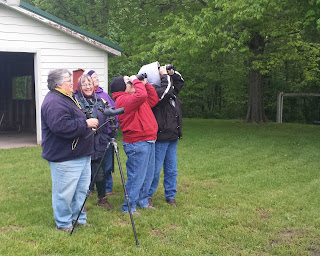
Therese Cummiskey (left)  uses her spotting scope
 to help participants find and identify birds.
(Photo by Scott Chamberlain)
Participants saw a wonderful variety of birds including bluebirds, cardinals, robins, Baltimore orioles, red headed woodpeckers, crows, vultures, hawk (not identified), chimney swifts, English sparrows, chipping sparrows, warbling vireo, cowbirds, chickadees, gold finches, grackles, a pair of Canada geese, and others. Also observed on the drive to and from Croton was a meadow lark, lots of red winged blackbirds, a male and female wild turkey, and a bald eagle.

The children wondered if a mother bird would take back a baby that someone else touched. To answer that, Therese put her hands on one of the boy's heads, then took them away, and asked the grandmother if she still wanted him. The response was “YES, OF COURSE. “ Therese said mother birds WILL take back their babies as they have strong maternal instincts. The hazard may be more about a predator smelling our scent on the baby bird and attracting unwanted attention.

When you see birds flying back and forth to the nest with bugs in their mouth, they could be feeding babies, or they could be feeding the mate sitting on a nest incubating eggs. To fledge a youngster, a chickadee may make 1400 trips back and forth with bugs. Birds are often spotted early in the morning when the sunlight touches the tops of the trees and any caterpillars or worms start moving around.

Binoculars are  available in various sizes. Therese recommended 8 x 42 as a good size for binoculars for bird watching. Anything with above a 10 x magnification requires a very steady hand. In a binocular with size 8x42, the 42 refers to the diameter of the lens objective which determines the amount of light that can go through it. More light going through the lens means the user gets a brighter

and more detailed image. You can buy very good optics with the less expensive ones around $150, a very satisfactory pair of mid-priced ones for under $400, and the upper end as much as $2400. Therese also brought along a spotting scope with very good optics and a friend installed a laser for her to get a good line of sight on a stationary bird so others could get a good look at the bird too. She explained that the way to use the binoculars is to look visually, keep your eye on the bird then lift the binoculars to your eye and you should be able to find the bird. Participants found this to be a very helpful suggestion. Therese cautioned that you should never look into the sun with binoculars as this can be harmful to your eyes.

Therese also identified many of the different bird songs heard, even if the bird could not be seen in the foliage. She also demonstrated a "spishing" sound that sometimes draws a bird out into view, as the birds think that other birds are fussing or fighting with each other. A woodpecker was heard drilling/tapping but was not identified. Later a red headed woodpecker was seen in the trees by the shelter house. Therese described different bird behaviors, flight patterns and habitat to help identify them.

Friends of Shimek President Ann Bennett said: “Therese was an excellent guide and teacher and we appreciate her traveling to meet Friends of Shimek at Croton for the birding outing.” For people who want to learn more about birds and birding, Therese’s favorite bird websites are http://www.birds.cornell.edu/AllAboutBirds/birding123/ ; http://birdwatching.com/(where she gets her binoculars and spotting scope); and http://ebird.org/content/ebird/
 

There is a complete guide to birding in the Croton Unit at
http://www.iowabirds.org/places/SiteGuide.aspx?site=26


Monday, May 16, 2016

Kiosk Replacement Project at Shimek State Forest

Forester John Byrd and the FOS Board of Directors announced today that the Kiosk Replacment Project planned last year has been completed.  Thanks to a grant of $4,500 from the Lee County Charitable Fund, DNR Shimek staff labor, and FOS Volunteer labor and funds provided by FOS donors and the Iowa Horse Council, all four information Kiosks in Shimek State Forest have been replaced.  This includes 2 in Lick Creek--one at each campground, one in White Oak and one in Bitternut Campgrounds.  These kiosks each have recycled plastic, plexiglas covered message boards that will be used to post critical information for campers and equestrians.  There are two message boards on those in Lick Creek to accommodate the informaton needed by equestrians. Information will be posted about DNR regulations, camping information, trail maps, Friends of Shimek information, emergency contact information, bio-security information and other items of interest to visitors to Shimek State Forest.


 FOS Volunteers painting the Kiosk constructed by DNR staff in the Lower Campground in Lick Creek.

The photo below shows the finished Kiosk in the Upper Campground, with the new message boards, installed by DNR staff,  ready to use.   If you have any special requests for the type of information to be displayed, please let us know.  FOS will utilize the board on one side and DNR the other.

Wednesday, May 11, 2016

Report on 5/10/16 FOS Group Work Day

The following report was submitted by Ann Bennett, Work Day Coordinator:

Despite all the rain in the forecast, we had a beautiful work day with sunshine and temps in the 60's.   Overnight rain meant the dirt trails had to be closed but the WWT was still open for riders.  Many thanks to the volunteers who helped get the campgrounds ready for the upcoming Memorial Day weekend.
 
 
  Firepits were cleaned out by Bill Fiordelise and Steph Lackquement, Linda Fiordelise and Jo Watson cleaned the gutters of the horse shelters, Bob Bender and Alan Ball checked all the picnic tables and replaced and tightened bolts, Lora Conrad bleached and scrubbed the pit toilets,

Ann Bennett and Pam Ball sorted redemption cans and bottles and walked the Wet Weather Trail near Hwy 2 to pick up trash and cans, John Byrd with Bob and Marsha Achenbach took a chainsaw and walked the Croton loop to remove an unpassable downed tree and cleared that loop, then came back for loppers and cleared trail out the  Upper Campground. 


 Denise and Gary Schieffer served a delicious lunch to hungry volunteers of sloppy joes, broccoli soup, salad, chips and brownies, with coffee or punch to drink.

Thank you to John Byrd in advance as he expects to take a small crew of volunteers out some time next week to cut downed trees off the trails if they dry up enough for 4 wheelers.  


John also had signs made to acknowledge the grants and agencies that contributed to the construction of the new horse shelters in 2013 and 2014.


The mounting blocks built by John Byrd and Ringo and Brenda Covert at the Upper and Lower Campgrounds are awesome and sturdy and we have already received comments from riders who used them.


Pam and Alan Ball took 4 grandchildren out to Shimek Forest in April to pick up trash and cans - a good way to teach children about volunteerism.  Then they roasted hot dogs and marshmallows.


Wednesday, April 13, 2016

Report on 4th Annual Shimek Education Day: Selecting Trees for Your Yard and Forest Management

Report on Friends of Shimek 4th Annual Education Day

Twelve people attended the 4th Annual Shimek Forest Education Day presented by Shimek State Forester, John Byrd last Saturday morning.  Despite its crisp beginning, the day was sunny and calm.   In the first part of the program, held at White Oak campground, John discussed urban trees suitable for yards and answered questions.  He recommended diversity in tree plantings due to insects like ash borers and some diseases affecting maples now.  This might mean using trees like ironwood or hackberry.  He recommended native species endemic to a location and encouraged land owners to become familiar with the type of soil and climate conditions in their yards and what type of trees are suitable for such a location.  He stressed the importance of using slower growing trees if you want a long lasting, strong tree. The fast growing trees like many of the poplars are not good choices as they come down easily in high winds.

  Here John is discussing which tree shapes/growth patterns are weak.

He mentioned evidence that a tree planted from seed can outgrow bare root trees or potted trees due to stress to the tree when it is replanted.  He also mentioned that any stress to a tree will shorten its life span, even though the tree may seem unaffected at the time.  This could be drought, insects, severe trimming, damage to the root zone.  He cautioned about planting root bound potted trees and how to cut the roots so a tree was not choked by its own roots winding round and round the pot as the roots can actually girdle the tree.   John mentioned new research about pruning certain trees when the sap begins running in the spring due to evidence that the new sap would heal a wound quickly versus pruning in the fall when the wound remains open until spring. He also stressed that you generally should not paint over a cut as that hinders the tree's own healing process.  Oak trees should never be pruned in the spring when sap is flowing due to the types of diseases that affect oaks.  John recommended mulching yard trees with 6 to 8 inches of mulch each year, being sure not to get any right up to the tree trunk and spreading it out far enough that you can mow around it comfortably.

Experts that you can contact for free help with tree selection and planting are the Iowa DNR district foresters. The District 5 Forester is Lisa Louck in Wapello at 319-523-2216 and the District 6 Forester is Ray Lehn in Fairfield at 641-472-2370. There are Iowa State Extension Service publications available online as well. One excellent article is from Iowa Outdoors entitled “10 Distinctive Trees to Plant” at http://www.cityofdubuque.org/DocumentCenter/View/22463
 
There is also a new DNR publicaiton availabe: Rethining Maple-Selecting Trees for Your Yard  - A Case for Species Diversity.  We have permission to post it here for your use--Click on this link:
 
During the second part of the program John discussed forest management at Shimek State Forest. This began with a walk in the woods at the White Oak Campground shown here, discussing how a forester manages a tract of timber for regeneration with various management practices. 

  Control burns reduce brushy growth of unwanted under story and this can release the growth of young trees like oaks by allowing more sunlight and less competition.  However, some under story is necessary to encourage the young trees to reach for the sky and grow long straight trunks, not like the low branching of a lone tree on the prairie.   Cutting down less desirable trees can release sunlight to choice trees.  Forest management is not just about the trees harvested today but more about trees being regenerated for harvest in the future.  For example, an oak tree may need 120 years to mature for harvest (not to be confused with a life span of 400 to 800 years).   Depending on the height and width of the trunk and any flaws noted like where a tree limb has left a scar, an oak tree may only be worth $100 at harvest after growing for 100 years!   Oak trees are a good harvest tree due to the amount of mast (nuts) produced for wild life and the value of oak trees for harvest.  There are many different species of oak trees in Iowa that thrive in different types of soil and conditions and are valued for different purposes.


                      Here John demonstrates how to estimate the board feet in a tree.


Next was a stop in the Lick Creek unit to see an area about 8 years into regeneration after harvest. John demonstrated how to estimate the number of young tree sprouts per acre with a simple device - a stick with a string to measure a circle of 6'7” diameter or 1/1000 acre and count the number of trees in that circle.  A reliable estimate require taking numerous such samples. He is hoping to achieve 2,000 to 5,000 oak sprouts per acre. This depends not only on his management process but the good fortune of having an excellent acorn crop from the nurse trees. A burn is scheduled soon in the area visited to remove some of the underbrush and let these young oak trees get more light. While learning about the forest, participants also observed a variety of other plants and mushrooms growing in the woods. Among these were a "hissing" mushroom known as the Black Tulip that is considered a harbinger for morel mushrooms, and early spring flowers including serviceberry trees in full bloom, Virginia blue bells, Dutchman's breeches, violets, spring beauties, toothwort, and even a Dogtooth Violet (trout lily.)

John Byrd is responsible for the management of over 9400 acres of forestland and has it in a ten year rotation for management practices so that he works with nearly 1,000 acres each year. Anyone can view the 300 page document for the management of Shimek Forest written by John Byrd and posted on the Iowa DNR website at
http://www.iowadnr.gov/Portals/idnr/uploads/forestry/shimek_managementplan.pdf

The Friends of Shimek thank John Byrd for spending the morning educating participants about urban tree plantings and forest management.

                                                     This photo is of the Black Tulip mushroom.
(This article prepared by Ann Bennett and Lora Conrad.)
 

Friday, March 18, 2016

Plans for Friends of Shimek Forest 4th Annual Education Day


On Saturday, April 9th at 8:30 AM, join us at the Shimek State Forest Headquarters just outside Farmington. Forester John Byrd will be our host for an outdoor, educational morning. The program will conclude about 11:am. The program is free.

The topics for the day are:

“Choosing the Best Trees for Your Yard “ Forester Byrd will provide tips on how to select trees for your yard that are right for your location and needs. The wrong tree selection can cost you time and money later if it has to be replaced. This will be held at White Oak Campground,


“ Selecting Forest Trees for Harvest and Post-Harvest Management.”  Forester Byrd will show participants why trees are marked for sale using a stand near White Oak Campground. Then participants will go to the Lick Creek Unit to discuss the first phase of regrowth at a site harvested in 2008. Whether interested in Shimek management or management of your own timber, come learn about this crucial phase of forest management.
We will be outdoors ---- come dressed for the weather and prepared for a short hike. We will drive or car pool to the other locations from Shimek Headquarters. 

To find the headquarters, from Hiway 2 in downtown Farmington, turn east/northeast (away from the river) onto J56 or Pearl Street.  Follow that road out of town and in maybe a mile, the office will be on your left.  There will be a sign.  The address is 33653 Route J56. Google Map gives good directions to the headquarters but some GPS systems do not.Please let John know if you plan to be there---while not required, it would be helpful for him to know about how many to expect. Everyone interested is invited; there is no charge. Just e-mail him at John.Byrd@dnr.iowa.gov or call him at 319-878-3811 and let him know if you plan to attend.